#MovementIsMedicine : Knee arthritis edition
/
A recent (super cool) research effort run by evolutionary biologists at Harvard looked at the skeletons of humans donated to museums, anatomy laboratories and medical schools. From studying these skeletons, some as old as 4000 years, and others as new as from 2015, what they found was that the prevalence of knee arthritis is going up despite our activity levels decreasing markedly as modern technology and living has moved people into more sedentary lifestyles.
I'll say that in more simple terms: since our average activity levels have dropped, our average rates of knee arthritis have risen. Osteoarthritis is NOT "wear and tear" and is NOT a result of you "wearing your joints out".
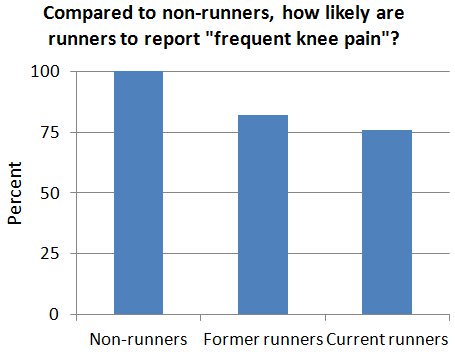
This graph shows a comparison of likelihoods of different groups reporting frequent knee pain. it means the "same" person who once ran is 20% less likely to have knee pain, and if they are still running, they're 25% less likely to have knee pain. Image from alex hutchison
This finding is yet another in a long line of research results that buck the intuitive belief that you get arthritis from doing "too much". We have data from people who report having been regular runners at some point of their lives (not necessarily at the time of their knees being tested) which shows they have "better" knees than their age-matched counterparts. That finding is totally separate to the multiple studies from around the world (Austria, Canada, USA to name a few) that show regular runners have "better" knees than those who are not regular runners.
From completely different research groups looking at completely different elements of knee health, we start to see a pattern that problems arise from long periods of doing "not enough" activity, and thus not stimulating the cells of your bones, muscles and cartilage around your joints to be supple and strong. Then when a person does get active, they are doing more than their weakened cells and structures can cope with, and things become painful, and the person - incorrectly - blames running on their sore knees, when in fact it had a lot more to do with the long period of not running prior to getting back into things!
The scientific method works by someone having an idea or belief (hypothesis) that they test. If the test proves the idea wrong, it is cast aside or refined to better reflect reality. If the test supports the idea, others will try and reproduce the test, or test the idea in another way. As the hypothesis passes more and more tests, the likelihood that it is a true reflection of what is really happening increases, until eventually it becomes considered a Theory, and is generally accepted to be our current best estimate of reality. Evolution is a good example of this, where direct observation is coupled with fossil records, DNA evidence and big data crunching (among other things), and we now have multiple convergent lines of evidence to strongly support the Theory of Evolution.
While the concept that Movement Is Medicine is by no means as well researched, articulated or supported as the Theory of Evolution, there are some clear indicators that there is genuine merit in movement being of huge benefit to humans. We have strong evidence from multiple different lines of inquiry which shows that inactivity is one of the surest ways to worsen the health of your joints (in this case, your knee).
Here at The Good Physio it is extremely rare that you will be told to simply rest when you present to the clinic in pain. It is in your best interest to keep moving if you are a habitual exerciser worried about "wearing yourself out" and to start moving if you've been putting off getting going again because you're worried about hurting yourself.
Book in to the Good Physio and we can work together on a plan to set and then achieve some SAFE movement goals for you, so you fit in the cohort of people with knees that are LESS likely to be sore.